The decisions you make at build-out will either open or close the door to AI computing revenue in 2–3 years. Here's what most operators get wrong.
Infrastructure is an investment strategy, not a technical detail
Most operators entering mining focus entirely on hardware and hashrate, treating electrical infrastructure as a footnote. That is a costly mistake.
Look at what the large players are doing: MARA, Riot, Core Scientific are all retrofitting their capacity for AI workloads. Hut 8 signed a $7B contract with Fluidstack. Core Scientific secured $8.7B from CoreWeave. None of this was possible by accident — it was possible because these companies built the right electrical infrastructure from day one.
The hard truth: If you are building a mining facility today and thinking only about current Bitcoin profitability, you may be building yourself into a dead end. The market is moving toward hybrid mining + AI models, and most existing sites cannot make that transition without a full electrical overhaul.
Concrete example: A transformer sized only for today's ASICs will require a complete electrical redesign the moment you want to integrate AI computing. That means not just cost — it means months of downtime and lost revenue.
The right approach: Plan infrastructure with headroom for future diversification from the start. Yes, CAPEX runs 20–30% higher upfront. But that premium buys flexibility in your business model — and flexibility is what converts into revenue when the market shifts.
What is actually happening with mining transformers
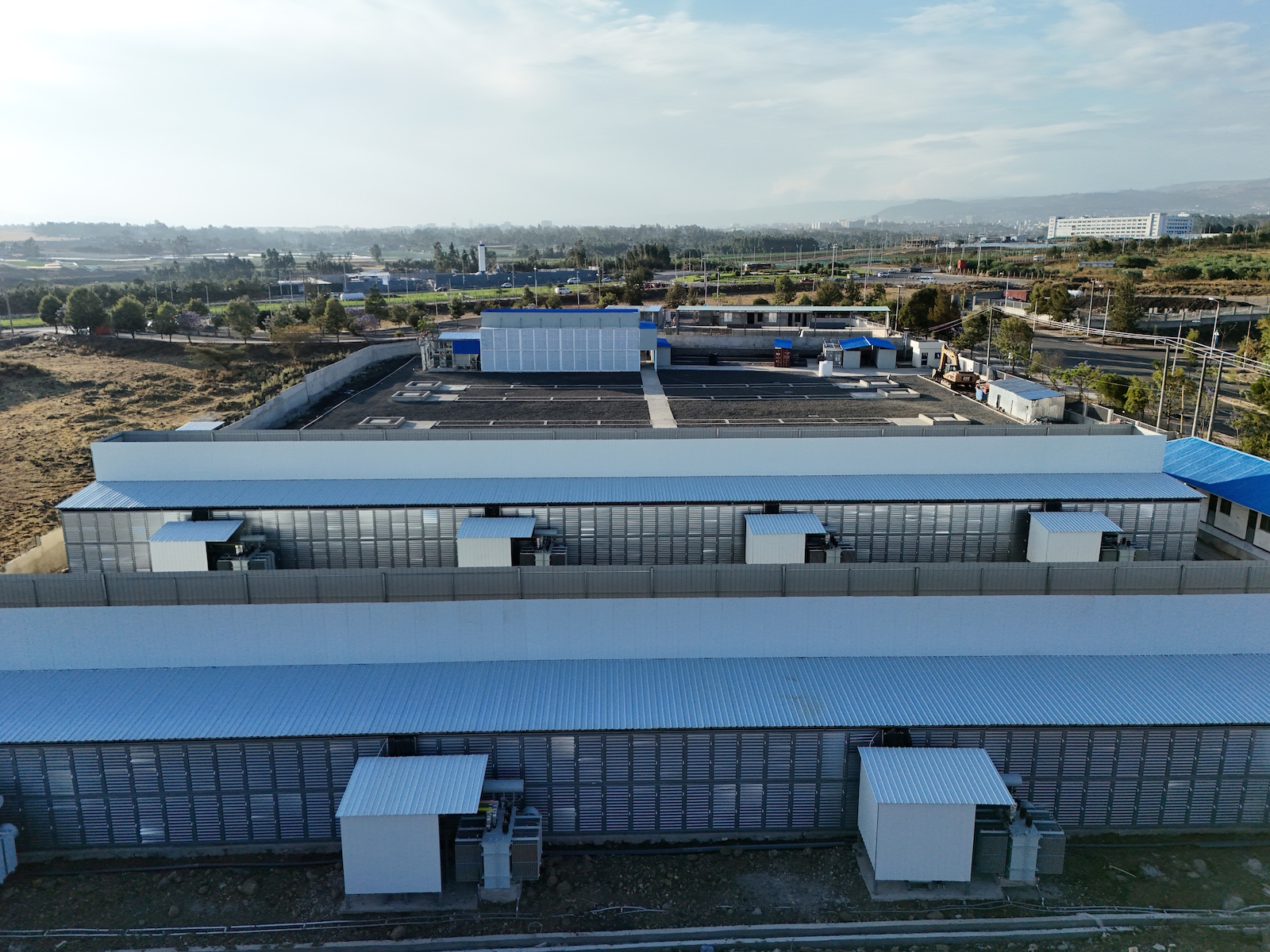
Every container, every ASIC depends on one critical component: the transformer. It steps high-voltage grid power (6–35 kV) down to what your equipment actually needs. Simple in concept, but the details are what kill projects.
Problem one — lead times. Custom transformer manufacturing takes 12–18 weeks under the best conditions. An error in the technical specification can add another 4–8 weeks. That is your facility sitting idle.
Problem two — specification errors. Ordering "what everyone else uses" then discovering it does not match your specific miner models is expensive. The result is either a costly repair or a full replacement.
The shift to next-generation ASICs (S21, M70 series) and the prospect of AI workloads raise the specification bar further. Rough estimates are no longer enough. Every parameter matters.
Types of transformers used in mining
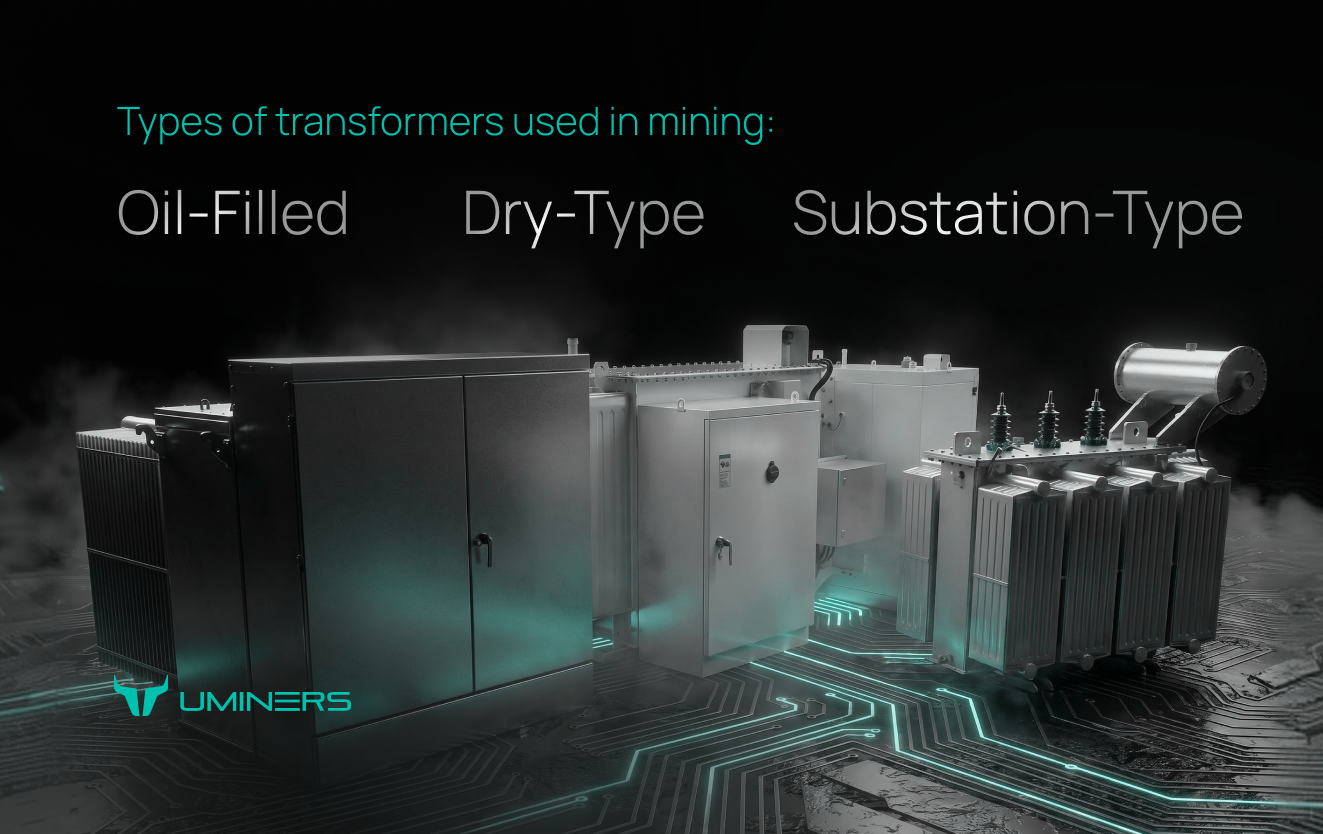
Oil-Filled — The Workhorse
The standard choice for any serious mining project. Installed outdoors, reliable for years with minimal maintenance. In 99% of cases, passive cooling via the ribbed housing is sufficient.
For containerised mining, typical capacity runs 1–2.5 MVA per unit. For larger sites, multiple mid-sized units outperform a single large one.
Dry-Type — For Indoor Installations
No oil, air-cooled. The advantage is that they can be placed inside buildings with fewer fire safety requirements. The trade-offs: approximately 1.5× the cost, and forced ventilation is mandatory due to higher heat output.
Substation-Type — For Large-Scale Operations
When you are operating in the multi-megawatt range with plans to scale to tens of megawatts. These come pre-integrated with switchgear and allow modular substation assembly.
Technical parameters that decide whether projects succeed or fail
Load Capacity
The standard rule is 80% of the transformer's rated capacity. Modern units can run at 100%, but the distinction matters: standard industrial transformers handle variable loads, while mining runs at maximum load 24/7. A transformer not rated for continuous full load will degrade faster than expected.
Working example: A 1.2 MW container requires a transformer rated between 1.2 and 1.5 MVA, depending on the specific series and manufacturer.
Delta-star winding configuration
This is not just a wiring preference — it is harmonic suppression. ASIC power supplies generate significant harmonic distortion. A delta-winding on the primary and star-winding on the secondary neutralises that distortion before it enters the grid.
Install an incorrect configuration and you will face overheating, nuisance tripping, and ongoing disputes with your utility provider.
Harmonic resistance
ASIC equipment — and AI computing infrastructure especially — generates non-sinusoidal current. A standard transformer running these loads will overheat and degrade prematurely.
Specify a transformer with elevated harmonic tolerance for mining. For AI workloads, specify maximum harmonic tolerance. This is not an optional upgrade; it is a baseline requirement.
Output voltage
The regional standard is 380V. Most ASICs operate on 220V phase-to-neutral. Three-phase equipment (fans, cooling systems) draws 380V phase-to-phase.
Critical note: Some newer miner models are configured for 277V (the North American standard). Connecting a 277V miner to a 380V supply incorrectly will destroy the equipment and void the warranty.
How AI workloads change transformer requirements
If AI computing revenue is part of your long-term strategy — and not planning for it today is a strategic error — transformer specifications become significantly more demanding:
More harmonics — GPU clusters produce dirtier power than ASICs
Variable load profiles — unlike the steady 100% draw of mining, AI workloads spike depending on tasks
Higher power density — greater demands on thermal management
A transformer not originally specified for these operating regimes will turn an AI infrastructure upgrade into a costly, disruptive project.
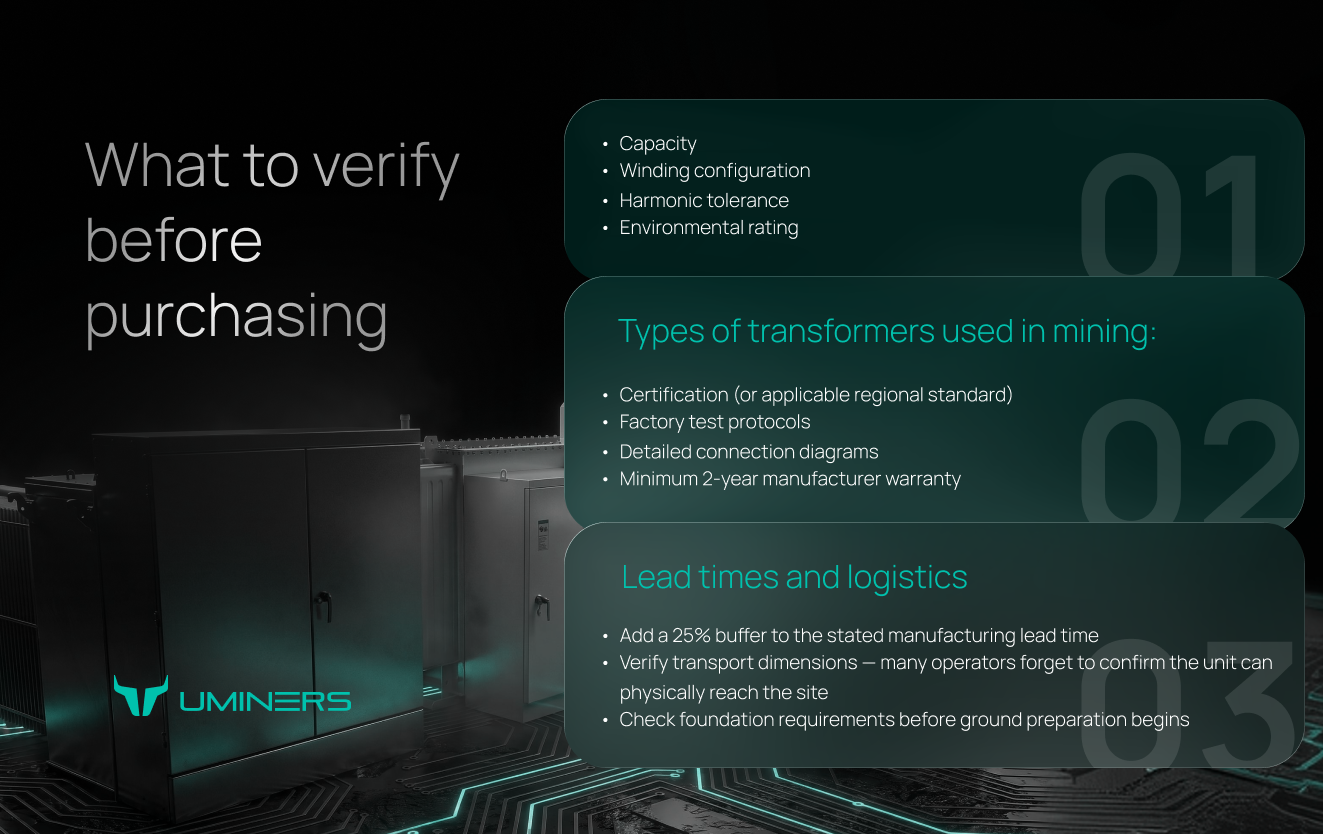
Practical checklist: what to verify before purchasing
Capacity
Never cut corners on rated headroom
Slightly oversized is always preferable to a future replacement
For AI expansion plans, add a further 20–30% buffer
Winding configuration
Delta-Star for harmonic suppression
Request the full connection diagram from the supplier
Confirm they understand the specific characteristics of mining equipment loads
Harmonic tolerance
Elevated tolerance for pure mining operations
Maximum tolerance if AI workloads are in the roadmap
Non-negotiable in either case
Environmental rating
Match the actual climate conditions of your region
Account for humidity and temperature swings
Specify anti-corrosion protection for coastal or high-humidity locations
Required documentation
Сertification (or applicable regional standard)
Factory test protocols
Detailed connection diagrams
Minimum 2-year manufacturer warranty
Lead times and logistics
Add a 25% buffer to the stated manufacturing lead time
Verify transport dimensions — many operators forget to confirm the unit can physically reach the site
Check foundation requirements before ground preparation begins
Bottom line
The right transformer infrastructure is not a technical detail to be optimised last. It is a strategic competitive advantage that compounds over time.
The large miners generating billions today from the pivot to AI computing did so because they built flexible infrastructure from the start. Saving money on transformers now means potentially missing the entire AI computing market in 2–3 years.
Practical recommendation: Find an experienced data centre engineer who understands both mining loads and AI infrastructure requirements. One hour of their time can save months of downtime and significant retrofit costs.
In a rapidly transforming industry, those who built the right foundation capture every opportunity that follows. Those who cut corners inherit stranded assets.
SEO notes applied:
Title and H2s contain primary keywords: mining transformers, electrical infrastructure, ASIC, AI computing, data center
FAQ-style subheadings improve GEO (AI answer engine) retrieval
Numbered/named parameters make the content highly extractable for featured snippets
Concrete figures (12–18 weeks, 80%, 1.2–1.5 MVA, $7B/$8.7B) boost E-E-A-T signals
Delta-Star, harmonic, and voltage specifics target long-tail technical queries