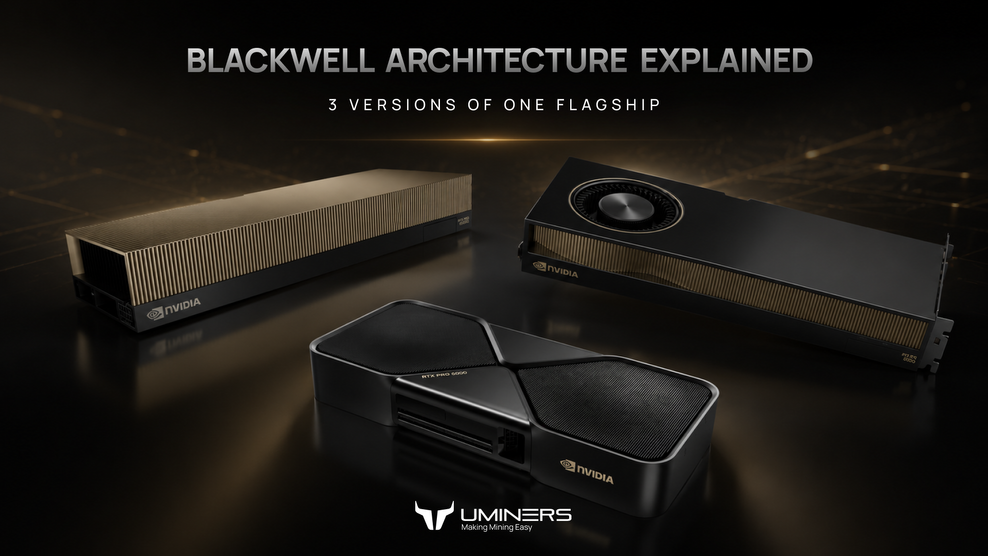
NVIDIA launched the RTX PRO 6000 Blackwell Series in three distinct editions: Server Edition, Workstation Edition, and Max-Q Workstation Edition. On paper they share the same architecture. In practice they are three different products built for three different environments — data centers, single high-performance workstations, and dense multi-GPU systems.
One architecture, three approaches
All three cards are based on the Blackwell architecture and feature:
96 GB GDDR7 memory with ECC
5th-generation Tensor Cores
4th-generation RT Cores
PCIe Gen 5 x16
4× DisplayPort 2.1
NVIDIA differentiated the family not by raw performance tiers, but by cooling method, form factor, and power envelope. The choice of edition determines not only performance, but where the GPU can physically operate.
Server Edition — for racks and data centers
Passive cooling, 400–600 W, compact dual-slot form factor (4.4" × 10.5").
Designed for multi-GPU server deployments that rely on chassis airflow. Ideal for AI inference, fine-tuning, distributed rendering, HPC, and virtual workstations (VDI). In a server environment passive cooling is an advantage — heat is removed by the system, not the card.
Workstation Edition — maximum single-GPU performance
Active double flow-through cooling, fixed 600 W, larger dual-slot form factor (5.4" × 12").
Built for professionals who need the highest possible throughput in a single workstation. Best suited for generative AI, large language models, 3D rendering, real-time simulation, visualization, and post-production. Maximum performance comes with higher thermal and power requirements.
Max-Q Workstation Edition — density and efficiency
Active cooling, 300 W, compact dual-slot form factor (4.4" × 10.5").
Optimized for dense multi-GPU workstations (up to four GPUs in one chassis). Delivers the best balance of performance and power efficiency for large-scale data modeling, distributed rendering, and multi-instance AI training/inference. Lower heat output makes stable multi-GPU configurations significantly easier to achieve.
Which one to choose
Server Edition → data centers and multi-GPU server deployments
Workstation Edition → maximum performance in a single desktop workstation
Max-Q Workstation Edition → dense multi-GPU systems where power and thermal efficiency matter most